Practical Poultry Info Index
- Bailey the Black Lab (4)
- Books (4)
- Broodiness (5)
- Brooding Chicks with a Hen (9)
- Building a Chick Nursery (3)
- Chicken Behavior (10)
- Chicken Maladies (10)
- Chicken Sex (4)
- Commercial Eggs (11)
- Constructing a Coop (6)
- Coop Equipment (6)
- Eggshells (3)
- Humor (4)
- Imprinting (2)
- Invasive Species (2)
- Meet the Flock (14)
- Molting (1)
- Parades! (2)
- Pecking Order (2)
- Predators (1)
- Wild Edibles/Recipes (2)
- Wild Esoterica (26)
Showing posts with label The Cochins. Show all posts
Meet the Flock Roundup – August 2017
Snowball the Silkie Rooster: Feeling very modern and sophisticated in his
fancy new hen pen.
Emile the Bantam Cochin Roo: "You conniving
scoundrel! Here you are in my coop with that menacing camera contraption again!
You've been warned! If you harm my hens in any way you will feel the wrath of
my fierce spurs!"
Meet the Flock Roundup - March & April, 2017
Meet Sam! Sammy joined the flock with a bunch of other chicks of a variety of breeds in 2013. Sam was a mystery chick at first - she didn't fit the pattern for any of the breeds and I was totally kerflummoxed as far as what she might be. I should have followed the rule of thumb, that if you don't know what a hen is, she's probably an Easter Egger - since they're not a true breed (they're a cross of any number of breeds with Auracanas/Americanas). Sure enough, when Sam started growing her distinctive (and highly attractive, I might add) ear tufts, I knew for a fact that she was an Easter Egger girl. Later, when she started laying those green eggs, that confirmed it!
Here's another picture of Sam. This is a picture from 2013, right after her first adult molt. Chickens can sometimes show subtle variations in feather patterns from one molt to the next and after this molt Sam had a delicate "necklace" of light gray feather. She lost this attractive feature after her next molt and it's never shown up again!
Meet the Flock Roundup - January & February 2017
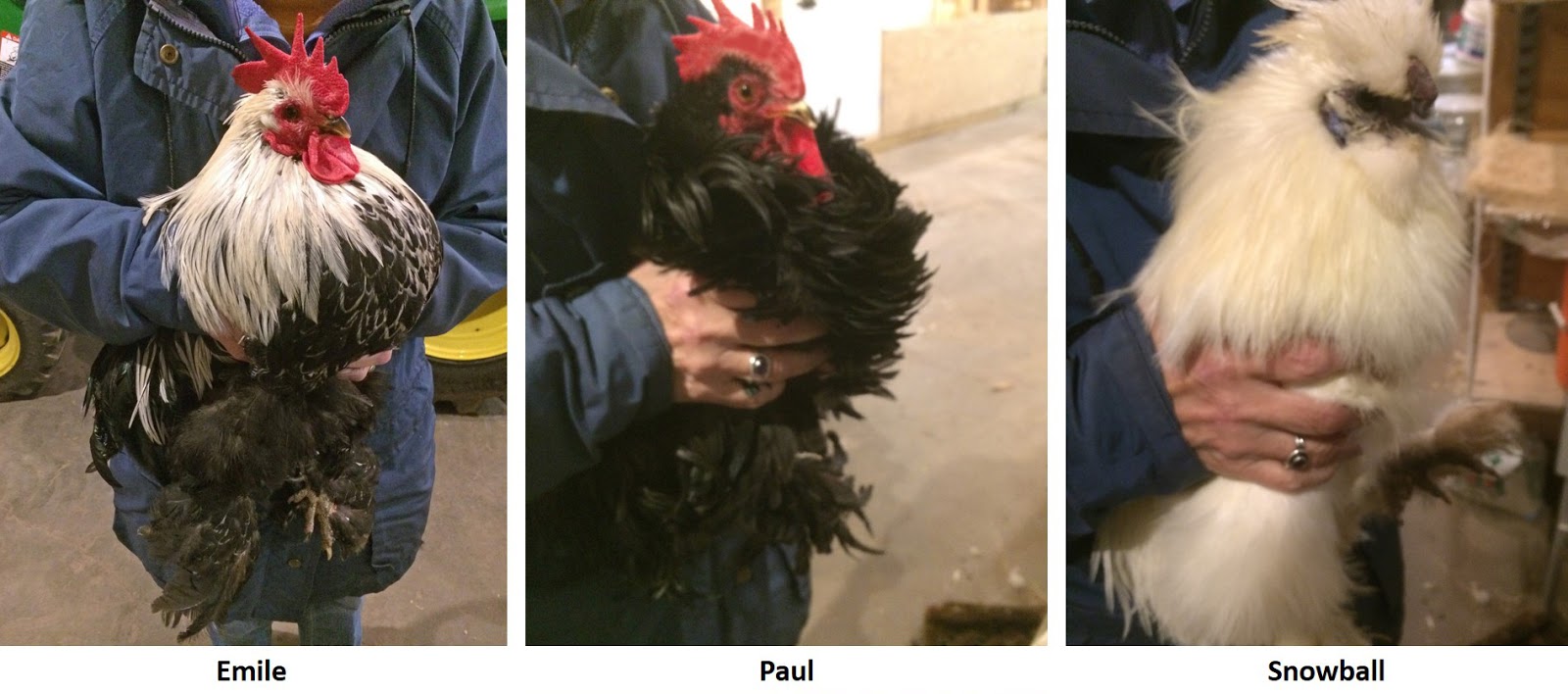
Meet Paul! Paul is my "second-in-command" rooster and is a frizzled bantam Cochin. "Frizzled" refers to his curly feathers, "bantam" to his diminutive size, and Cochin is his breed - a sweet-tempered, feather-footed breed that originated in China. In this shot, Paul is out for a walk in the leaf-covered chicken run in mid-November.
Spurs!
Roosters (and some hens!) have spurs – a claw-shaped
projection on their legs just above their feet.
Spurs start out as small bumps on young chickens and gradually grow into
long, curved, sharp weapons. And they are weapons. Roosters use their spurs to defend themselves
and their flocks. When a rooster
attacks, he propels himself forward feet first, intending to slash his opponent
with his spurs. People who engage in
cockfighting (which,
thankfully, is now illegal in all 50 states after Louisiana banned it in 2007),
cover their fighting roosters’ spurs with long metal spikes called gaffs. This guarantees that the spur, which can be
injurious enough in its normal unadorned state, will be even more harmful—thus
increasing the blood, fatalities, and excitement for the spectators of the “sport”. I’m referring to this brutality as sport only
because that’s how it is characterized in the parts of the world where it
remains legal. But I’m getting a bit off track
from the topic I really want to talk about—trimming roosters’ spurs to make
them less dangerous. In addition to removing a weapon, spur
trimming also helps protect hens from being injured while mating with the
rooster. And since spurs can become
amazingly long, shortening them can actually make it easier for the rooster to
walk.
Last week, my wife, Kathy, astutely noticed that one of Emile’s spurs
was so curved it was almost winding back into his leg. Spurs sometimes can actually grow all the way
back into a rooster’s leg, causing pain and lameness. I don’t know how Kathy even noticed Emile’s
spurs since his legs are covered in dandy feather pantaloons all the way down to
his feet, in the usual Cochin style. But
when I got a chance to get a closer look, I saw the curved spur as well and
decided it was time for Emile to get a pedicure, and I further decided that we
would take care of all the guys while we were at it.
If you were to x-ray a chicken spur, you would see that the
tip is solidly made of the same keratin-rich horny material that covers the
entire spur—it’s the same material that is in a chicken’s toenail and it’s dead—there
are no nerve endings or blood supply. Starting
about half-way down the spur and going all the way to the leg, there’s an inner
core of living tissue, and inside this core is bone—an extension of the chicken’s
tarsometatarsus. (Watch me toss around the hundred-dollar
words! That’s the official name for the
bone a chicken’s leg shank.) The
presence of an inner core of bone make spurs more analogous to horns than
toenails.
It’s good to have a mental picture of the inside of a spur
when you’re trimming. If you trim too
closely to the leg, you'll cut live tissue and could even cut into bone. If you cut in the right place, it’s as simple
and painless as trimming toenails.
Spur trimming is really a two-person job. You need one person to hold the squirming,
frightened rooster, and one person to wield the trimming tool. There are three different methods—each with
its own tool:
One choice is to trim the
spurs with a sharp dog nail clipper. The
operative word here is “sharp.” A dull
clipper can function more like a nutcracker and actually crack the entire outer
layer of the spur—not good! You should trim
about a third of the distance from the end and keep in mind if you trim too much
you’ll be cutting into live tissue. It’s
a good idea to have styptic powder on hand in case you hit live tissue and
cause bleeding.
A second method is to
use a Dremel pet grooming tool—an electric tool with a rotating file at the end
that’s designed for filing dog toenails.
There’s no chance of cracking the spur with a Dremel and you’re probably
less likely to go too deep and cause bleeding since filing is such a gradual
process. The down-side of a Dremel is
that it is gradual. Filing a spur can take some time, and
meanwhile you’re holding this unhappy, frightened rooster. And then, a Dremel is a bit pricier than even
the best clipper.
Another technique is
to grab the spur at the base with pliers and gently squeeze the pliers while
wiggling the spur back and forth.
Eventually the entire outer layer of the spur will detach and you can
pull it off, leaving the living core behind.
You will definitely need styptic powder for this procedure—there will be
blood. Many resources that I respect
offer “uncapping” as viable method for trimming spurs, but I can’t get past the
notion that it’s on par with pulling out someone’s fingernails. There’s no denying that desheathed spurs
will bleed and that the rooster will feel pain.
I'm a proponent of the dog-clipper method, and that’s
exactly what we did. It was quick and
painless. The hardest part was managing
to apprehend all three guys!
Kathy was the holder and I was the trimmer. Each rooster in turn got quickly and painlessly trimmed while frantically thinking, "What is HAPPENING TO ME!?"
Emile's nearly ingrown spur
Not only is Paul the smallest of the roosters, but he's also covered in very silly frizzled feathers. So it's so ironic that he has HUGE spurs. Ah, life.....
[This post has been shared on Clever Chicks Blog Hop #227]
“Meet the Flock” Roundup—September & October, 2016
Meet Darcy
Barred Rock, the fourth hen in the quartet of Barred Rock hens that rule the
Hipster Hen roost. Darcy isn’t super friendly like Arlene, she isn’t super
clever like Barbara, and she isn’t super bossy like Charlie. She is, perhaps,
one of those individuals who would be characterized by all observers as “the
other one”. But I don’t think Darcy cares. I think she knows that she’s SORT OF
friendly and clever—and maybe just a little bit bossy. And other than that
she’s happy to be the hen that goes about her business of laying one of those
nice brown eggs nearly every day!
Meet Emile,
the birchen Cochin rooster. Well, actually, you’ve already met Emile. This is a
recent picture that I like quite a bit that I had to share—Emile in all his
roosterly splendor!
Meet Emily,
the plump and personable black Silkie hen. Emily really does have eyes but
they’re hard to see because they’re sort of hidden in her fluff and they’re
black--just like the rest of her. Emily’s eyes, and the rest of her for that
matter, are hard to photograph. She just sort of absorbs all the light and ends
up looking like a silhouette. I haven’t ever taken a picture that I feel does
her justice, but she’s so darn cute I’m gonna keep trying!
Emily the
Silkie stares contemplatively through the chicken run fence on a nice fall day.
Meet Maran
the cuckoo Marans hen. She’s pictured here with her constant companion, Carmen
Maranda. Maran and Carmen are in their third year—these two girls and Angitou
the golden Polish hen joined the flock as babies in the summer of 2014 and came
from Murray McMurray
Hatchery in Webster City, Iowa. Marans can come in nine different colors,
but Maran and Carmen’s cuckoo color is the most common in the US. In addition
to being pretty birds, my Marans hens lay beautiful dark chocolate brown eggs.
Here's
Carmen Maranda and Maran the cuckoo Marans hens as kids in the summer of 2014,
along with their friend Angitou the golden Polish hen.
Meet Marissa
the Cream Legbar. I captured this picture of Marissa in August—about the time
she started laying eggs. Since then, Marissa has laid a pretty little
blue-green pullet egg almost every day, and each egg is incrementally larger
than the previous one. My older hens have scaled waaay back on egg production
lately, since they’ve started their fall molt. So many days the four eggs I get
from my four young Legbar hens outnumber the eggs I get from the rest of the
flock!
Here’s
Jennifer, my fourth year white crested black Polish hen. Jennifer
was so sick that I removed her from the flock for a while in late September,
but she did a rapid and spectacular bounce-back and I’m happy to report that
she’s completely recovered now. I was
sure that Jennifer would be eager to model the new chicken sweaters, but
she apparently felt otherwise.
In Memorium: Sweet Roxie the Rhode Island
Red. Gone but not forgotten.
Sweater Girls
This post is about chicken sweaters. No, really! But first I need to tell you about Emile the rooster. Bear with me. We'll get there.
Back a few years ago, when Emile was a mere teenage cockerel, he got a bad case of sour crop. He reached a point where he was all hunched up in a corner, staring into space and literally near death. Happily, I was able to bring him back to good health and full recovery. He became an amazingly docile and friendly little rooster after he recovered, maybe because of all the handling that was necessary when he was sick. But I like to think that maybe he was just grateful.
Anyway, over the
last year he’s undergone a huge change in attitude. He makes it clear whenever I go into the coop
that it’s his coop, not mine, and
that he’s in charge not me. There have been a few instances where he’s
taken me on—actually lunged at me feet-first with those long pointed
spurs. This usually happens when he
feels I’m harassing his hens in some way, but sometimes it’s just because I
maybe look at him wrong, or possibly only because he’s in a foul (um, fowl)
mood. Being attacked by an enraged
rooster could be disconcerting if it weren’t for the fact that Emile is a
bantam Cochin roo and the biggest thing about him is his ego.
When he goes on the
attack, I usually respond by putting on a pair of gloves to avoid contact with
those spurs, then I pick him up, pet him, and tell him that he just needs to
think calm thoughts and concentrate on his breathing. This really does seem to calm him, although
for all I know he may just be icily plotting his revenge.
Pecking Order/The Further Adventures of Arlene
In 1904, there was a ten-year-old boy
living in Norway named Thorleif. In
addition to having a really cool name, Thorleif was also a very keen observer
of the things that happened around him.
He was utterly captivated by a flock of chickens that his parents had
given him and spent hours watching them interact. In 1921, Thorleif Schjelderup-Ebbe used the
observations that he had collected since childhood on the dominance hierarchy
in chickens as the basis for his doctoral dissertation. Since his doctoral paper was published in
German, he used the term “Hackordnung” to describe this chicken behavior.
When his paper was published in English in 1927, this term was translated
as “pecking order.” “Pecking order” has
now seeped into popular usage to the point that it not only describes social
interaction in people, but also an economic theory, a card game,
and a chicken restaurant in
Florida. As a matter of fact the
term has become such a part of the common lexicon that most people have
forgotten, or never knew, that it has anything to do with chickens.
![]() |
| Thorleif (Oslo Museum) |
But chickens do peck each other. They have pointed beaks, and their beaks are their main weapon. In the most extreme situation, chickens can peck each other to death. That's unusual, though, and most chickens in most flocks go through the day without major squabbles. That's not to say, though, that chickens are Kumbayah clucking pacifists. There is a social structure and chickens are constantly trying to move up the ladder. The top chickens get their pick of the prime spots on the very top of the roost and get to eat the choicest treats for as long as they like. The bottom chickens find the best spot on the roost they can, and get any leftover treats that the ruling chickens don't want. And while pecking is involved in maintaining the social norm, it doesn't always come to that - usually a dirty look from a more dominant hen is all that's required for the weaker hen to back down.
The flock
of sixteen birds in my big coop actually contains two pecking orders. There are fourteen hens and two roosters in
the flock, and whenever a flock contains more than one rooster, there is a
pecking order for the roosters that is distinct and separate from the hen
pecking order. With only two roosters,
it’s pretty easy to see how things fall out for them. Emile is the top banana. Then, there’s the small auxiliary rooster,
sad little Paul, the frizzled bantam Cochin.
Emile has his way with the ladies whenever and wherever he likes. Paul will occasionally flirt with one of the
hens, and if that hen is not one of Emile’s favorites, or if Emile’s feeling
magnanimous, he’ll ignore the situation.
But if Paul puts a move on Emile’s best girl, or if Emile is in a foul
(ahem…fowl) mood, he’ll chase Paul around the coop until Paul finds a good
place to hide or Emile decides he’s tired.
This goes on every day and will not stop as long as both roosters are
healthy and occupying the same flock at the same time.
The dynamic
of the fourteen hens is a little more complicated. I could tell you in general who the top hens
and bottom hens are, but to actually make a list of the hens from top to bottom
would be very difficult because there is constant shuffling going on. A hen will move up or down a position due to
some subtle interaction that either I don’t witness or I see but don't realize the implications. In general, I’m positive
that Arlene, Barbara, Charlie, and Darcy—the four Barred Rocks—make up the
ruling elite. In general, Barred Rock
hens are intelligent, curious, and adventurous, and are most often the alpha
hens in any flock.
Roosting
time is the best time to watch flock dynamics.
Emile goes to bed early on the top rung and one by one the hens jump
onto the roost to join him. Paul knows
that Emile is loath to get up once he’s settled in for the night, so he knows
this is his big chance to troll the coop for acquiescent hens. Each hen, meanwhile, works her way up the
roost to the top rung and carefully examines the hens already sitting there to
see if there is a hen near her status that she can roost by. If the top rung is already full, she looks
for a hen she can force to move down. If
a hen is not happy with who she winds up roosting by, she’ll not so subtly shove
her body against her roost neighbor and try to force her to move. If that strategy doesn’t work, she’ll casually
start pecking the other hen’s toes. The
pecking escalates to the body, the neck, the head, and finally the comb. Combs are sensitive, vulnerable, and bleed
easily, so the conflict usually ends before it reaches that point when the weaker
hen reluctantly moves to a lower rung. Occasionally,
if the lower hen feels she can take on the hen challenging her and move up a
peg on the pecking order, a full-scale hen fight can ensue, which often ends
with Emile’s intervention.
While all
this shuffling and sorting out is taking place, the Barred Rocks are still
lazily scratching through the coop bedding, or pecking feed. They know that when they decide to go to bed,
they’ll pick any spot on the roost that they damn well please.
And this is the law of the coop. It may offend your sense of fairness and
democracy, but it’s a system that works, and without a system there would be
constant bloody conflict. There are
several situations that cause the system to break down. One is when I introduce a new hen to the
flock. That hen has to fight for a
position in the pecking order, or be mercilessly bullied by all of the other
hens all of the time. Putting a couple
of new hens into the mix always causes a kerfuffle that lasts for several days,
and when the dust and feathers finally settle, the new pecking order can look
very different from the old one. A
second situation is when a hen dies. The
sudden death of Rhoda the Rhode Island Red last week opened up a position
in the hierarchy and there was conflict.
Some hens moved up, and interestingly, some hens moved down. A third situation is when a hen is
injured. Hens that rank below her
immediately press their advantage. Recall
last week’s post about Arlene and Rhoda.
Both hens, when they were ill, felt safer on the ground, outdoors, with
evening approaching, than in the coop with other hens that would probably pick
a fight. A fourth situation is when a
hen is temporarily removed from the flock.
When she goes back, she has to regain her position in the scheme of things. And that brings us to Arlene.
You’ll recall from last week’s post
that Arlene has been under the weather with a lame right leg compounded by a
hard molt. She’s been gradually
recuperating and on Thursday night at roosting time, I decided it was time to
move Arlene back to the coop with the other hens. I swung open the door separating her corner
pen from the rest of the coop and Arlene sauntered out. Most of the hens didn’t react at all to
Arlene’s reappearance among them, but there were a few that did, and it was
interesting to see who they were. First,
Paul the pipsqueak rooster scurried up, bubbling with amorous excitement. I interpreted his ardent clucking to mean,
“Arlene! You’ve been away! I suspect that the decline in your fortunes
means that Emile no longer finds you attractive. But suddenly I find you
so…..approachable!” Right behind Paul
were Arlene’s “friends”, Barbara and Charlie Barred Rock. They seemed to be saying, “Hey, sister, looks
like you’ve got a little limp going on. That
is sooo not cool! While you were away we
saved your spot. NOT! There’s no way we ever want to hang out with
you again, so take a hike now, or
you’ll be sorry!” Of course chickens
don’t really talk. What they were
actually doing was aggressively pecking Arlene.
While I realized that it was important for Arlene to get through the
hazing and reintegrate into the flock, I also didn’t want the situation to get
out of hand, so I waited it out in the coop as the chickens, one by one, found
a place on the roost for the night.
Arlene eventually limped back into her old corner pen and roosted by
herself.
I got up early Friday morning, but
not early enough to be up with the chickens.
By the time I got to the coop the nasty behavior was once again in full
swing—Paul was doing his Lothario routine and the mean girls were
bullying. Arlene was constantly on the
move to avoid their attention and her limp was becoming more pronounced. Also, her comb was bleeding in several places
from hard pecks. I said a few words
under my breath, snatched up Arlene, put her back in the corner pen and shut
the door.
![]() |
| Arlene--with comb scabs after a "conversation" with the mean girls |
And that’s where she is today. While Arlene actually seems perfectly happy to be living by herself in the corner pen and with free run of the tractor alley, it isn't a good or permanent solution. She needs to eventually reintegrate with the flock. I'm going to give her some time for her leg to regain some strength and for her comb to heal and then I'll give my next plan a shot: I'll put Arlene back into the coop and do a little social engineering to help her fit in. I have a plan! Will my plan work? Who knows - but it's worth a try. Life in the coop never gets boring!
![]() |
| Barbara Barred Rock |
![]() |
| Charlie Barred Rock |
![]() |
| Paul the amorous frizzled bantam Cochin roo |
[This post has been shared on "Clever Chicks Blog Hop #222"]
"Meet The Flock" Roundup - May & June, 2016
Here's a recent picture of Angitou the Golden Polish hen. Angitou went through a rare spring molt (chickens typically lose their feathers and grow new ones in the fall). She looked like a porcupine for a while with all those pin feathers sticking out, but now she's got all that shiny new plumage & is quite attractive. Angitou lays an abundance of small white eggs, & has a sweet personality - she's happy to be picked up & carried around.
Meet Angitou the Polish hen as a child! The popularity of the Facebook post on Angitou was pleasantly surprising. That was the first of a planned series of pictures of the chickens in my flock. I chose Angitou for the first one not because she is the prettiest, or my favorite, but simply because I decided to do it alphabetically. But due to Angitou's new-found fame, here's another of her - a photo from her childhood! She's about six weeks old in this 2014 shot.
Meet Emile. Flock provider and protector or abusive polygamist? You be the judge. Emile is a bantam birchen Cochin and the alpha rooster in my flock. Cochin is the name for Emile’s breed - a fluffy footed chicken breed that originated in China. Birchen describes his handsome silver and black color pattern. Bantam refers to his diminutive size but in no way reflects on his attitude. As the alpha roo, Emile is a busy guy - always hurrying from one part of the run to another to end interpersonal kerfuffles between the hens and he is always vigilant and on the look-out for predators while the flock nonchalantly pecks and scratches its way through the run. He would fight to the death to defend his hens and has actually taken me on more than once when I’ve had to pick up or interact with a protesting hen. A less positive attribute is that Emile is a busy guy in other ways. His quest for “favors” from the hens is never-ending, and he regards the whole flock as his “hens with benefits”. He does perform a cute little courtship dance (stay tuned for a movie of the “Emile Shuffle”), but that’s all he’s got – no witty repartee, no flowers and no candy. It’s just dance then hop on. And he doesn’t understand the concept of “consent”. His idea of consent is when the hen doesn’t run away. No, actually, his idea of consent is when the hen doesn’t run away fast enough. A pretty primitive attitude, perhaps, but excusable in his case – he’s a chicken, don’t you know.
This sweet hen is Willow the buff Orpington, one of the senior members of my flock. Orpington is the name of Willow’s breed. Orpingtons were originally developed near Orpington in the county of Kent, England. “Buff” refers to her pretty yellow color. Willow is a large hen – so large that I’ve always worried about her injuring herself as she ungracefully flies/jumps/falls off the roost each morning. I’ve always tried to get to the coop before her attempt and have gently lifted her down. Unfortunately, my fears have been realized and Willow recently sustained some sort of injury. I noticed that she had developed a limp. There was nothing obvious when I looked her over and I’ve hoped that she would eventually recover, but instead she’s actually gotten worse. Willow now walks slowly and no longer roosts at night – she can’t jump onto the roost. The worse part of her situation is the abuse she gotten from Emile the rooster. Emile is looking for “favors” from his hens constantly and his idea of consent is when the hen doesn’t run away fast enough. Poor Willow can’t run. And Emile likes it rough – Willow is missing feathers on her back where Emile digs in with his spurs, and the back of her head is bald where Emile grabs on with his beak. Willow is now living in a shelter and has a restraining order against Emile. The restraining order was issued by me and the shelter is the center part of the pole barn where I normally keep tools and park the tractor. She’s living there by herself, but she can visit the chickens in both coops through the fence any time she wants. She’s eating well, is bright eyed and alert, and while she is still moving around slowly, she seems to be improving. Eventually, I may introduce her into the small coop with Snowball and the Silkie hens and see how that goes. It’s a little less rough and tumble there, and she may fit right in.
This is Arlene, a Barred Plymouth Rock hen. “Barred” refers to her black and white stripes and Plymouth Rock is the name of her breed – a breed developed in New England in the early 1800’s. Pretty much everybody shortens Barred Plymouth Rock to “Barred Rock.” Arlene was among the first batch of chicks I got in 2013 and has the distinction of being the first hen ever to lay and egg here at the ranch. When she was younger, Arlene would fly up to my shoulder so she could see the world from a higher perspective. She apparently feels that sort of behavior is not appropriate for an adult hen, since she’s stopped doing it. She still does persistently follow me around the coop and will occasionally peck me on the leg—not to be aggressive but just to remind me that she’s there.
Meet Barbara the Barred Rock. At the risk of being risqué, this is a picture of Barbara taking a bath. Chickens, counterintuitively, take a bath by wallowing in the dirt. They usually find a spot in the chicken run with exposed dirt and dig a hole to get the dirt loose, then they roll around in the dirt while flapping their wings and kicking their feet to make as big a mess as possible—all the while clucking contentedly. Then they get up and produce a huge dust cloud by shaking themselves off. I’m sure that if you asked them they couldn’t tell you why they do this, but the process does destroy mites and other critters that like to live in chicken’s feathers and suck their blood. Since my Minnesota hens can’t dust-bathe outside when the ground is covered with snow, I have this section of cement culvert on its side in the coop which I keep about half full of a mixture of sand, wood ashes, and diatomaceous earth. It is big enough for two or three chickens to take a communal bath while others perch on the edge and socialize. Stay tuned for a movie of Barbara dust bathing that I shot at the same time I took this photo!
The Birds and the Bees and the Chickens
If you’ve Googled your way to
this blog looking for poultry porn, you’ve come to the wrong place. Sorry to disappoint you, Foghorn, but this is
simply an informational and scientific discussion of chicken mating.
If, however, you are offended by
the concept of animals having nonchalant sex in public, this may be the wrong
place for you, as well. I grew up on a
farm so animals having sex everywhere
– all the time was simply part of my
childhood, for goodness sake! So it’s
hard for me to appreciate why anyone would make a fuss about it. If you’re going to make a fuss, though, just
leave now and remember that this is the warped and twisted blog where they talk
about vile animals having disgusting relations.
Coop Update
Here are Nicky and Paulette, half of the Legbar teen foursome, chillin' and hangin'. The teenage Legbars are seven weeks old this week, and like all teenagers they hang out. Since they don't have a mall to hang out in, they've decided that the happening place to be is the nest boxes. This is unfortunate, because, like all teenagers, they're not very tidy. The adult hens know that nest boxes are for nesting and keep them clean. Since the Legbar teens think they're for hanging out, they use them for their own personal toilet space - much to the consternation of the adult hens and me. Maybe I need to post a "no loitering" sign.
In an earlier post, I talked about how I was planting oats in the chicken run. Well, the oats are growing well and today the chickens are out in the run enjoying them. It's a seventy-degree afternoon with a slight breeze and lots of sunshine dappled by the shade of the oak trees. Think the chickens are happy?
Another shot of some of the chickens enjoying the oats in the chicken run. That's Sam the Easter Egger in the front, then going around clockwise, we've got Rhoda and Roxie, two of the Rhode Island Reds, then Paul the frizzled bantam Cochin roo, Jennifer the Polish hen, and finally Buffy the Buff Orpington. With all that green stuff in their diet, I expect lots of eggs with dark orange yolks, choc full of omega-3's.
A May Day at the Chicken Ranch
It's been a fine day here at the ranch. I grabbed the camera and spent some time in the coop this afternoon and captured some pictures of the chickens enjoying life on this fine May day.
The Legbar chicks will turn six weeks old at the end of the week and in chicken-years are definitely teenage chickens now. They now have 24/7 access to the coop where Emily, Angitou, and Snowball live and hang out there most of the day. Courtney still takes them back into their own coop at night. Here, from left to right we've got Marissa, Bonnie, Nicky, and Paulette.
Marissa and her mom, Courtney are enjoying a light afternoon snack.
Here's Marissa again - I guess she was just being photogenic today. She's proudly standing on a roost that's about two feet off the ground. Just today, Paulette found her way to the high roost that's four feet off the ground. She was quite proud of herself.
Meanwhile, out in the big chicken yard, the hens all scratch, peck, and enjoy the spring weather while Emile the birchen Cochin bantam rooster keeps watch from the hen yard perch in the background.
Here's Jennifer the White Crested Black Polish hen being beautiful.
Out in the chicken run, Snowball the Silkie roo and Angitou the Golden Polish hen are having a great time digging through a leaf pile.
Another fine day filled with scratching, pecking, clucking, and laying eggs. Life is good.
Emile!
Here’s a recent shot of Emile, the dandy little birchen Cochin roo!
Emile has become my bud since I nursed him back to health from his bout with
sour crop. All of the handling has made him less shy & he's quite happy to
eat grain out of my hand now. He crows at sunrise, just like roosters should
& sometimes at other random times of the day when he gets confused.
I was clueless as far as what was wrong with him when he first
got sick. I just noticed that one morning, he didn't crow, or do much of
anything and just sort of stood around with a droopy head. I wondered at first
about coccidiosis, which is something all chickens get at some point, or some
other infectious agent, which would have probably meant that the whole flock would
get sick. I finally hit on the idea that he might have sour crop, and sure
enough, when I tipped him over, nasty stuff ran out of his beak just like I was
pouring cream out of a pitcher. With the
help of a neighbor, who is a vet, I’ve managed to get this little guy back to
good health!
Subscribe to:
Posts (Atom)