Randy's Chicken Blog Has Moved


Well, Randy's Chicken Blog followers, this is it.  This is my last post on the old website.  I've moved from Blogger to a brand-new platform with a new domain name.  I feel like I've barely moved in at the new site--there's still a lot of stuff in boxes--luckily they are all virtual boxes.  My new home is with Squarespace. Making the move is a bit of work, but ultimately, Randy's Chicken Blog will have a fresh new look with a lot more functionality! Go on over and take a look!  Like it says in the picture, the address is randyschickenblog.squarespace.com .


Need to check out the info from one of my old posts?  For the time being, all the old stuff will continue to be archived right here!

Meet the Flock Roundup - May & June 2018


The latest bit of paraphernalia that I've added to the coop to keep the girls entertained is a small mirror. Here Moe the Faverolles takes a quick look to make sure her feathers are all attractively in place.

A Carton of Eggs: Part 5—Vital Farms Organic Pasture-Raised Eggs


An egg carton: Great for keeping a dozen fragile eggs grouped together and cushioned.  Also, great as a blank canvas that can be filled with written and visual messages.  This is the fifth in a series of articles about all that info printed on an egg carton.

Also in this series:


For my fifth venture into egg carton messaging, I picked up a dozen eggs from Vital Farms at my local Whole Foods.  I first heard about Austin, Texas based Vital Farms when I ran across their very amusing and spot-on ad on the net.  In addition to being really funny, this ad calls “bullsh*t” (their word choice!) on all those eggs labeled “cage free.”  When you buy eggs with “cage-free” stamped on the carton, you probably think you’re doing the right thing.  Cage-free eggs are a huge improvement from eggs that come from hens living in tiny, cramped battery cage torture chambers.  But as Vital Farms points out in its ad, hens laying cage free eggs probably live in one square foot of space in a cramped barn and never get to go outside.  Vital Farms advertises its eggs as “pasture raised” and guarantees that each hen gets 108 square feet of outdoor space.  These seemed like my kind of eggs, so I bought some and then took a look at the information on the carton.

Meet the Flock Roundup - March & April 2018


 Moe the Salmon Faverolles saunters through the tractor alley in the pole barn. I let the girls into this normally chicken-free space occasionally in the winter to break the monotony. On warm days I open the pop door to the chicken run whereupon all the hens rush to the door, take one look out and exclaim, “What?? There’s still snow out there!  Why would we go out there?”

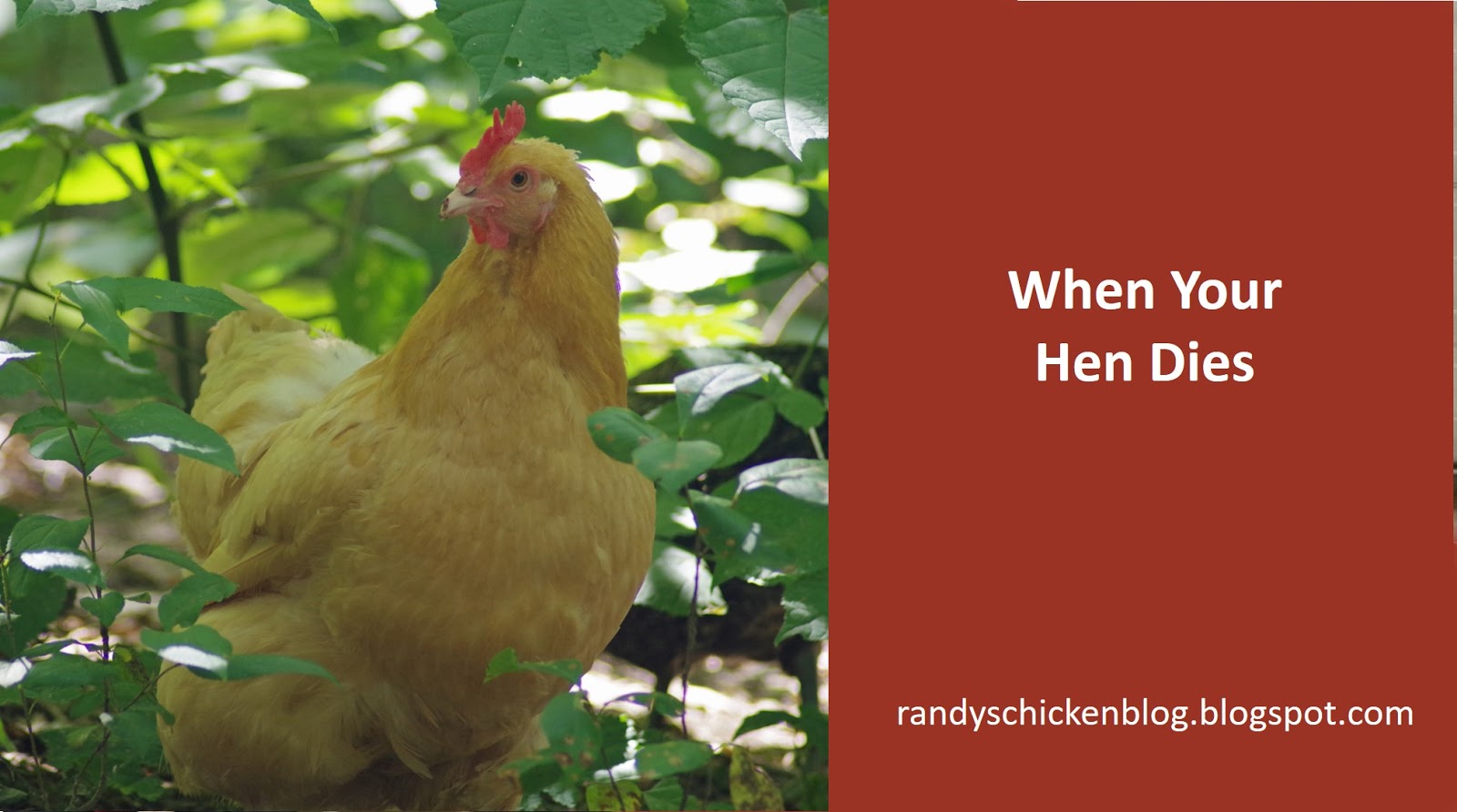
When Your Hen Dies


I dedicate this post to the memory of Snowball the Silkie Rooster, whose good and happy life in my coop ended just last week.  And to Arlene, Emily, Courtney, Angitou, Buffy, Willow, Veronica, and Charlie - all of whom passed within the last 12 months.  It’s been a tough year for the flock—and for me.

Arlene
There was a hen who lived in a coop in your backyard.  Now she’s gone.  Her death surprised you, but what surprised you even more is the sense of emptiness and sadness you feel after her passing. 

There’s an unpleasant fact about keeping chickens that you probably didn’t think about when you first brought home your little peeping bundles.  That someday they would die.  Nobody likes to talk about it, but it’s something that you can’t ignore.  If you have chickens, you’ve no doubt become attached, and sooner or later you’ll have to deal with their deaths.

A Short History of Organic Eggs


Readers:  I'm transitioning my blog to a new platform on Squarespace.  I've updated this blog post and moved it to the new location.  Click here to get there! - Randy


Randy's Chicken Blog participates in the Amazon Services LLC Associates Program, an affiliate advertising program designed to provide a means for sites to earn advertising fees by linking to products available on Amazon.

Randy’s Chicken Blog Celebrates Two Years


Last year as I celebrated the first birthday of Randy’s Chicken Blog, I announced that the blog had just achieved 10,000 views.  Now, a year later I’m just shy of 30,000 views and am happy to have readers all over the US, as well as a variety of other countries.  Some of you are faithful followers of my Facebook page, but many folks have read a single post on a single topic and found that post through Google.  I love my followers of course—each and every one of you, but I’m also happy to provide information to those people trying to get an answer to one nagging question.

There have been, if you include this one, 132 posts.  All of them are always available in the archives, and they have covered every aspect of a chicken’s life from hatch to death.  Some posts stray off topic a bit to talk about the woods around the coop and the wild plants and animals that live there, or a few good books about chickens that I’ve read, or the treatment of chickens on farms, or well…life, the universe, and everything!

The subjects of the most popular posts cover that same wide range, from stories about specific chickens to information about egg cartons.  Here are thumbnails of the ten most popular posts from the past year with links to the actual posts.  Thanks for reading them and stay tuned for more!


On Halloween Day last year, I posted this article about the mystery of the unusual chickens in South America.  It seemed to me that it would fit with Halloween if I gave it an outer-space theme. Paulette the Cream Legbar modeled as the alien chicken.

Meet the Flock Roundup—January & February, 2018


Here’s Squawky the Speckled Sussex pullet. Not only is she pretty, but she’s got to be the world’s friendliest chicken. She makes it hard for me to walk through the chicken run because she’s always right there with me – right underfoot!

Coop - A Year of Poultry, Pigs and Parenting – A Book by Michael Perry


I picked up this gem by Michael Perry eight years after its publication.  Maybe I just wasn’t paying attention—I don’t know how I missed this book for so long.  Not only is it a first-rate and compelling book, but I feel like Perry is speaking directly to me.  Needless to say, his other books are now on my reading list. When I first cracked open the cover, I was expecting a story about chickens.  That’s not what it’s about. To be sure, chickens are minor characters in this book, but it’s a memoir—so it’s really about Michael Perry.  Perry tells us the story of his first year in an old house on a Wisconsin acreage with his new wife and daughter, with frequent flashbacks to his childhood on a Wisconsin dairy farm amidst an “obscure fundamentalist Christian sect”.  Along the way he discourses on home birth, milking cows, slaughtering pigs, building a chicken coop, and even blowing one’s nose using a technique he calls the “farmer snort”.  And ultimately, perhaps he offers us his perspective how one should live one’s life.

Are Chickens Dinosaurs?

Composite picture: T. rex courtesy of the ever generous public domain - Emile the rooster courtesy of Emile the rooster

Here are some statements for your consideration:

  •    “Tyrannosaurus rex was really just a big chicken.”
  •    “Chickens are the closest living relative to Tyrannosaurus rex.
  •    “Chickens are directly descended from T. rex.”
  •   "Chickens are dinosaurs"
Lately I’ve been running into declarations like these a lot, and I’ve got to say that I wasn’t buying most of them.  None of these statements, it seemed to me, had the ring of truth.  So, I decided it was time to get to the bottom of the dino/chicken thing and find out if there really is some sort of connection between dinosaurs and chickens and if so, what it is. And, after some research, here we go:

Where Did Chickens Come From? The Domestication of the Chicken


Consider this:  You’re an ancient Egyptian pharaoh, you want to let everybody know about your war exploits and plunder, and social media hasn’t been invented yet—what should you do?  Well, if you’re Thutmose III, the Napoleon of ancient Egypt, you inscribe all of your immodest assertions right onto one of the walls of the great Karnak temple for all people to see.   Fortunately for Thutmose III, inscribing information into stone has given it a bit more permanency than a blog entry or a Facebook post might have.  People have been looking at those inscriptions for over 3000 years, and the “Annals of Thutmose III” are still there on the ancient walls of the ruined Karnak temple in Luxor, Egypt for all to read. 

Meet the Flock—November & December 2017


Here’s a shot of Carmen Maranda the big Cuckoo Marans hen having a meditative moment in the chicken run.

Here’s my photogenic little bantam frizzled Cochin roo, Paul!


Millions of Mistreated Chickens—The Truth About Meat Chickens

“You don’t have to be a vegan to wonder if it is right to put another entire species in perpetual pain in order to satisfy a craving for chicken salad and deviled eggs.” – Andrew Lawler, “Why Did the Chicken Cross the World?”


There have been a few readers who have taken umbrage to my posts about the mistreatment of chickens.  And I get where they’re coming from.  It can be distressing to navigate to my blog looking for pictures of cute Hipster Hens happily pecking and playing in my coop, and instead get hit over the head with stories about millions of chickens being mistreated.

But here’s the deal—if you scroll down to the bottom of this page you’ll find Randy’s Chicken Blog's mission statement.  There you’ll find these declarative sentences: “My chickens are really cool.  All chickens are really cool. The majority of chickens being raised for meat or egg production, in spite of their inherent coolness, are treated cruelly. You can help make changes by your purchasing habits. Educate yourself! Read labels! Check company websites!”  I think it would be unethical to blog about chickens without also discussing the issues surrounding the treatment of commercial chickens. While it’s great that we love our backyard hens, we can’t lose sight of the fact that the majority of the chickens alive in the world right now have miserable lives.  It is important that we chicken appreciators stay informed about the situation because we do appreciate chickens and we recognize them to be intelligent, sentient creatures who have the capacity for joy, but also the capacity to suffer.

A Carton of Eggs - Part 4 - Locally Laid


An egg carton is great for keeping a dozen eggs grouped together, and for providing eggs stability and cushioning in transport.  Beyond that, an egg carton is a very useful marketing tool.  All that blank space can be filled up with information, promotional messages, and art.  This is the fourth in a series of posts about the stuff printed on specific egg cartons. 

Also in this series:


For this post, I went to a nearby supermarket and bought a carton of Locally Laid eggs.  In my own coop, the Hipster Hens were in the midst of their autumnal molt and egg production was incredibly low.  Given that we had some house guests who expected their morning scramble, I really did need to buy some eggs anyway.  And in buying the eggs I also got a carton to blog about. So, I killed two birds with one stone, right?  Please don’t tell the Hipster Hens I was talking about killing birds.

Locally Laid is a Minnesota-based, family owned and run egg company that has recently expanded into Iowa and Indiana.  Jason and Lucie Amundsen started Locally Laid Egg Company in 2012 to provide pasture-raised eggs to local markets and as proponents and practitioners of “Middle Ag”.  My backyard flock of Hipster Hens currently tops out at 26 birds.  Cal-Maine Foodsthe nation's largest egg producer, the last time anybody counted, had around 26 million hens.  Locally Laid has around 1800 laying hens.  Middle Ag.  Get it?

Winter Non-Chickens

Not all of our feathered friends are chickens.  We’ve got a collection of birdfeeders by our house that draw in birds both winter and summer.  Last spring I posted pictures of the spring migrators that stop by our feeders on their way north in a post I called "Spring Non-Chickens".  In this post I'm sharing some pictures of some of the year-round residents that show up at our feeders in the wintertime.  

Of course in the winter, we don't have the variety of bird species showing up for their sunflower seed or suet snacks that we see in the spring, but quantity perhaps makes up for diversity.  The feeders are busy from sunup to sundown, so we don't have to wait to be entertained - all we have to do is look out the window anytime we want!

Here are a few examples of what we see:

This is a female purple finch enjoying a sunflower seed.  We get both purple and gold finches in huge flocks in the winter.  The purple finch is, of course, really hard to tell from the house finch.  Is the bird in this picture really a purple finch or is it a house finch?  I'm going with purple, but I could be wrong!

Meet the Flock - September & October 2017


Marissa the Cream Legbar sez “Braaaaak! Don’t take that shot! If you hold the camera that close I’ll look RIDICULOUS!”

Here’s a nice shot of Paulette and Marissa the Cream Legbar hens from about a year ago – they were just starting to lay eggs!

Paulette could be the world’s most molty chicken in this shot! She only has two tail feathers left, but she’s really, really proud of them!

Chickens from Outer Space?


I’ve always been interested in ancient sites and have been fortunate to be able to visit a few of them over the course of my life.  Not unsurprisingly, I often meet others who share my interest in timeworn architecture and ancient civilizations when I visit these sites.  I also bump into another whole subset at these old places—those searching for sites imbued with “secret, ancient power”.  Visit Stonehenge, Delphi in Greece, or Machu Picchu and you’ll run into them, alone and in groups, in shorts and hiking boots or robes and beads, seeking healing, omens, visions, or doorways into other dimensions. 

Betty the Transgender Chicken – What Happened Next


Randy's Chicken Blog has moved to a new platform. You can find this story plus all sorts of other chicken info and tales of the Hipster Hens right here!

Sexing Chickens: The Art, Science, and History of Hen vs. Rooster


A farmer wanted to be able to tell which of his baby chicks were boys and which were girls so he enlisted the aid of a scientist.  “Well!”  said the scientist, “It’s really quite easy!  You simply scatter some crickets in the coop.  The boy chicks will only eat boy crickets and the girl chicks will only eat girl crickets.”

“That’s great!”  said the farmer. “But how do you tell the boy crickets from the girl crickets?”

“Why are you asking me about crickets?” the scientist retorted.  “I’m a chicken expert!”

And for the bulk of history after the domestication of chickens, sexing baby chicks wasn’t too far from that mark.  The bad news is that baby chicks are pretty much small, cute, fluffy, and indistinguishable, with their boy and girl parts mostly inside their bodies and out of sight.  The good news is that for a long time, it really didn’t matter a whole lot.

Six Things to Do When Introducing New Chickens to Your Flock


Remember your first day at your new job?  You walked in carrying your little file box containing not much more than your coffee cup and your potted plant and found your way to your new office.  Everybody’s stared at you and you didn’t know any of them.  You didn’t know where the break room or the bathroom was—you didn’t know where anything was, and you weren’t sure what you were supposed to do next. 

Now, imagine that all your new co-workers had beaks and were crowding around to maliciously peck at you and you’ll be pretty close to what it must be like to be that new chicken you’re introducing to your flock.  Which is why you can’t just open the coop door, toss in a few new chickens and hope for the best.  It will be a stressful time for you and your flock, but with a little planning and strategy you can make it a little less stressful.